You've searched for how to build a second brain with Claude. You are not alone, a small industry of guides now exists for exactly this: point Claude Code at an Obsidian vault, and let it read, write, and organize your notes for you.
It's a real improvement over the folder-and-tag era. Builders who've done it report it working, genuinely. Notes get structured. Reading gets synthesized. A book you fed it last month turns up connected to an article you fed it yesterday. That's not nothing. It's still not what you think it is.
The New Capture Trap
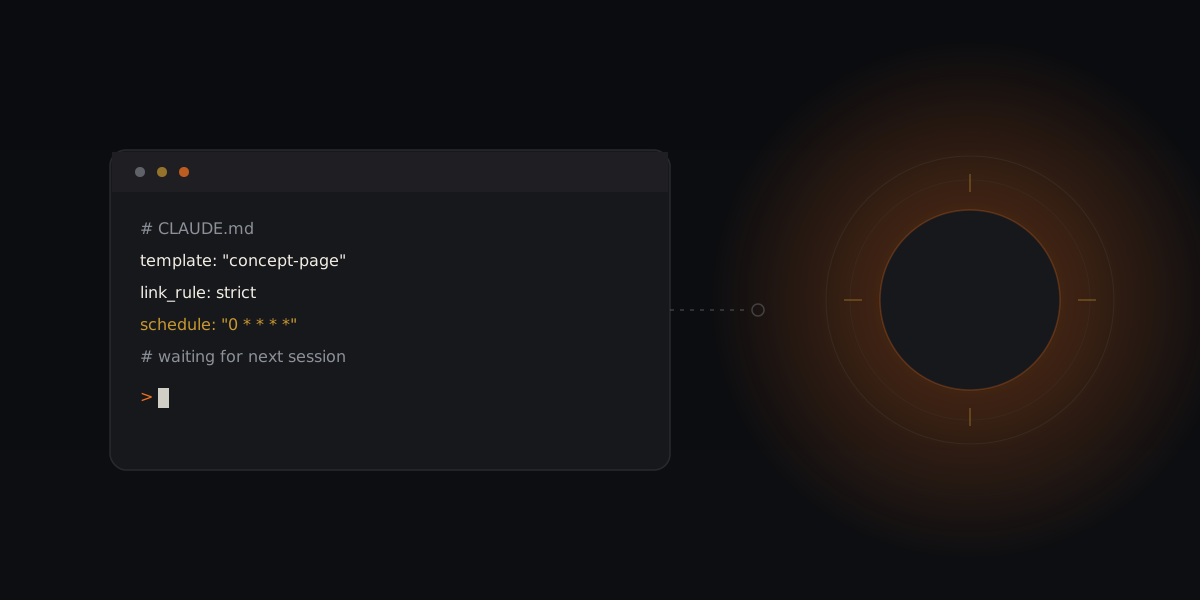
Here's the pattern showing up across a dozen tutorials this year, and it's more elaborate than it first sounds. You create an Obsidian vault with folders for books, articles, and a wiki. You write a schema file, usually a CLAUDE.md at the vault's root, that tells every new Claude Code session your tagging conventions, your page templates, your linking rules, before you've asked it a single question. You drop in a source. You tell Claude what to extract. It reads the content, writes structured markdown pages, adds YAML frontmatter, and links related concepts with [[wikilinks]]. Open Obsidian's graph view and you'll see it: a web of nodes, four books producing eighty-plus interconnected concept pages across half a dozen domains.
Scale that up and you get the fuller version: an ingestion pipeline that pulls from an email inbox, an RSS feed, or a shared drive folder on a schedule, often hourly, chunks the new material, runs it through a processing prompt, and writes the structured output to a database. Add a vector store on top, Pinecone, Weaviate, Supabase's pgvector, and you get semantic search instead of keyword matching. This is retrieval-augmented generation: retrieve the relevant records, inject them into Claude's context, generate an answer grounded in what you've actually stored.
It is, without question, more capable than a Notion workspace with a chatbot bolted on. It is also, underneath the new vocabulary, the same 30-year-old premise: the problem is capture, and the fix is a better capture system. Tags became embeddings. Folders became a vector database. Manual filing became a cron job. The busywork moved from your hands to your terminal, it didn't disappear, and neither did the belief that caused it.
Ask yourself the question that actually matters: does this system tell you something before you ask it to? Or does it wait, beautifully organized, until you remember it exists and type a query?
The Schema Is Everything, and That's the Tell
Listen to how the people who've actually built these systems describe the work, in their own words: "the schema is everything." "A vague schema produces vague output." "I iterated on mine several times, tightening the linking rules, defining page structures precisely." "Constraint improves quality", telling Claude exactly how selective to be about which concepts get linked produced better results than an open instruction to "connect related ideas."
Read that list again as a description of a system that's supposed to think for you. Every one of those sentences describes a human doing design work, writing the instruction manual, defining the fields, deciding what counts as a good connection, before the system produces anything useful. The output quality is a direct function of how much upfront engineering you did. That's not a criticism of the people building this; it's genuinely clever use of the tool. But it's not what "automatic" means. A system that only works as well as the schema you personally wrote for it is a system you are still operating.
Why the Vector Database Doesn't Change the Deal
Claude Code is genuinely good at this job. It can read your vault's structure, understand how your notes relate, and synthesize an answer that pulls from a dozen files you'd never have connected by hand, describe a decision you're facing and it can pull a framework from economics, a pattern from biology, and a principle from a book you read eight months ago, in one answer. That's real progress over search-by-keyword.
But look at what the mechanism actually requires of you, step by step. You designed the memory architecture. You built the retrieval logic. You're the one who has to open a session, describe the problem, and ask it to go pull from your vault. The retrieval-augmented-generation pattern underneath all of this is explicit about the sequence: a question arrives, the system searches for relevant records, the records get injected into context, Claude generates an answer from them. Every step in that chain starts with a question. Nothing in the chain starts with Claude noticing something on its own.
Between sessions, nothing is thinking. The hourly ingestion job runs on your schedule, not on the rhythm of your own thinking, it picks up a new file when the cron job fires, not the moment an idea becomes relevant to a decision you're making right now. A system that answers brilliantly when you ask it the right question is still a system that needs you to know the right question exists, which is why perfect recall of everything you've stored still doesn't close the gap. The insight you buried in a note three weeks ago doesn't surface itself just because it's sitting in a vector database instead of a folder. It surfaces when you go looking, and you only go looking for what you remember to look for.
That's the tell. You didn't eliminate the Capture Trap by making it programmable. You just became its engineer instead of its filing clerk.
The Maintenance Bill Nobody Mentions
Every honest account of running one of these systems eventually gets to the same list, and it's worth reading in full: check for duplicate records before writing new ones. Build retry logic for when the ingestion job fails silently, and it will fail silently if you don't build in logging for it. Set a monthly review to archive or delete stale, low-relevance records, because a knowledge base that only grows becomes its own version of the information overload it was supposed to fix. Watch for Claude misclassifying a topic or inventing a connection that isn't really there, and adjust the prompts when it does.
None of this is a criticism of the engineering, it's careful, well-documented advice from people who clearly know what they're doing. But notice what kind of advice it is: ops work. Someone has to be the systems administrator for their own thinking, monitoring the pipeline, pruning the database, rewriting the prompt when the output drifts. The going rate for a personal setup like this, once you're paying for API calls, an automation platform, and a database, tends to land somewhere under $30 a month, cheap, as infrastructure goes. The cost that doesn't show up on that invoice is the ongoing attention the system demands just to stay useful. You built yourself a research assistant. It came with a part-time job attached.
What Actually Compounds Your Thinking
Personal Intelligence starts from a different premise: your thinking should compound the way interest compounds money, automatically, without you designing the schema, scheduling the ingestion job, watching for failed retries, or opening a session to ask.
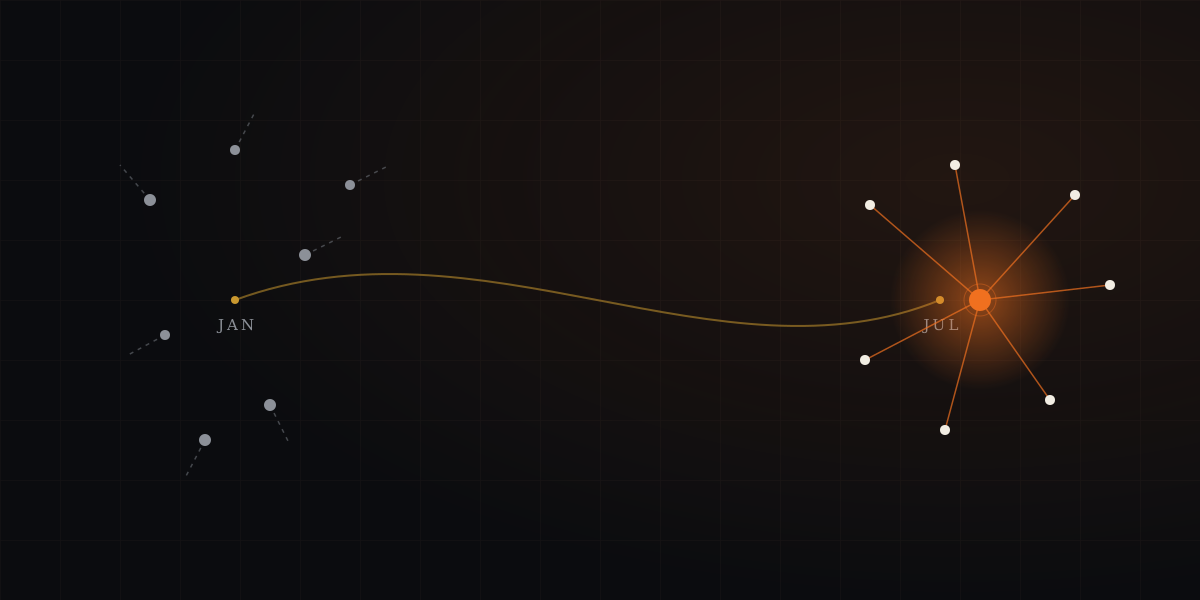
This isn't a smarter way to query your vault. It's a system that learns how you specifically think, your patterns, your goals, your open loops, and acts on what it finds before you ask it to. It connects the note you made in January to the decision sitting in front of you in July, without you remembering the note existed or writing the prompt that would surface it. Nothing needs a schema you wrote yourself. Nothing needs a monthly pruning pass. It just needs to be yours.
The difference isn't Claude Code versus Ovandor as tools. It's a system you have to operate versus one that operates on your behalf.
What This Looks Like
Say you spent a weekend setting up exactly this: Claude Code, an Obsidian vault, a CLAUDE.md schema you wrote and refined twice, an hourly ingestion job pulling from your read-later queue. Three months in, you have a genuinely good research assistant, every book you feed it gets structured, tagged, and linked into the graph, and when you ask it a sharp question, it gives you a sharp answer pulled from places you'd forgotten.
Now say a decision lands on your desk that quietly contradicts a call you made in March, buried in a note you haven't opened since and never tagged as related to anything current. Your Claude Code setup will confirm the contradiction beautifully, the moment you think to open a session and ask. But you have to think to ask. Nothing in the pipeline flagged it while you were building the decision, because nothing in the pipeline runs unless the schedule fires or you type a question. Your Personal Intelligence already flagged the contradiction, before the decision was final, without a cron job and without a query. One system waits for the right question, however well you engineered it. The other one doesn't wait.
FAQ
Can Claude Code build me a second brain? It can help you build one, reading, writing, and organizing an Obsidian vault on your behalf, following a schema you design. What it builds is still a retrieval system: it answers what you ask, on the schedule you set up. It doesn't act on its own until you open a session and ask it to.
Is Claude Code good for a second brain? For synthesizing an existing vault of notes when you ask it a specific question, yes, genuinely capable, and a real upgrade over keyword search. It still requires you to write the schema, maintain the ingestion pipeline, and remember to ask. That's engineering work, not intelligence that acts without you.
Do I need a vector database to build a second brain with AI? Only if you're building a retrieval system yourself. A vector database makes search smarter; it doesn't make the system proactive. Nothing surfaces automatically just because it's embedded, it surfaces when you query it, same as a folder, just with better matching.
What's the difference between a second brain and a RAG system? A second brain is the goal, an external system that holds your thinking so it can compound. Retrieval-augmented generation is one technical way to build toward that goal: retrieve relevant records, inject them into an AI's context, generate an answer. RAG is a mechanism for answering questions well. It isn't a mechanism for noticing something before you ask one.
How much maintenance does a Claude Code second brain actually need? More than the pitch suggests. Builders who run these systems describe monthly pruning passes, duplicate-checking, retry logic for failed ingestion jobs, and periodic schema rewrites when the output starts drifting. The ingestion can be automated. The judgment about what the system should be doing can't, that's still your ongoing job.
What's the difference between a Claude Code second brain and Personal Intelligence? A Claude Code second brain is a pipeline you design, schedule, and query, and keep maintaining after launch. Personal Intelligence is a system that already knows your patterns and surfaces what matters before you ask, no schema to write, no pipeline to run, no monthly pass to keep it honest.
The Capture Trap is over. Your thinking, compounded. Your next action, surfaced. Nothing lost. Nothing to organize. Just intelligence, personal, proactive, yours.